2009/01/18

Sunday, January 18

A glimse of Liberia in the 1950s

A good friend of mine sent me an interesting link to a 1958 movie of the visit of Prince Bernard of the Netherlands, the Prince Consort of Queen Juliana, to Liberia. The short movie, made for the Dutch National News Broadcasting Company ‘Polygoon Journal’, shows President William Tubman, Vice President Tolbert and other prominent Liberians.

Liberia in those days was a heaven for foreign investors and the movie shows pictures of ‘the world's largest rubber plantation' being Firestone's, and of Bomi Hills, where Liberia’s first iron ore mining company LMC (also) exploited the richness of the Liberian soil. The Dutch were very present in the rubber and mining sector. Not commonly known, it was a Dutch geologist, H. Terpstra, who in 1934 had discovered the Bomi Hills iron ore deposits, and most of the Bomi Hills ore was shipped to the Netherlands.

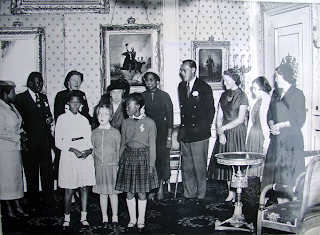
Relations between Liberia and the Netherlands were strong in those days. In October 1956 President Tubman had made a State visit to the Netherlands. The picture below shows President Tubman and his family together with Queen Juliana, Prince Bernard and their four daughters, among whom the actual Queen Beatrix, in the monarch's Soestdijk palace.

Prince Bernard would again visit Liberia in 1962 whereas Queen Juliana reciprocated with a State visit to Liberia in 1974.

The 1958 movie can be found here. Unfortunately, the accompanying text is in Dutch but for those who are interested how Liberia looked like in those days the movie is still worth watching!

Shots: arrival of Prince Bernard on Robertsfield airport, officially welcomed by President Tubman - the Executive Pavillion, Ashmun Street, Monrovia - Pioneers monument - Providence Island and an aerial view of Monrovia - market scene - Liberia Mining Company, Bomi Hills - the Firestone rubber plantation - Liberian dances, Klay District - departure of Prince Bernard. The official end of the movie (10 minutes) is followed by shots filmed by Prince Bernard himself.

PS With only 45,000 inhabitants, Monrovia then was one of the smallest capitals in the world.

2009/01/12

Monday, January 12

Good news:
Liberia has made considerable progress in restructuring its $ 4.7 billion debts

Last year Liberia obtained an important debt relief when in March it fullfilled a number of conditions under HIPC which cleared the way for an agreement with the Paris Club. The following month, Paris Club creditors agreed to restructure Liberia’s external public debt of about $ 1.5 billion, 97 percent of which consists of overdue arrears and interest. An important amount was immediately cancelled – over $ 250 million – whereas nearly $ 1 billion was rescheduled although the latter arrrangement also meant that a debt to the International Monetary Fund was replaced by a debt to the United States (see my posts of March 19 and 28).

Following the April 2008 agreement with the Paris Club - a voluntary gathering of individual creditor countries – Liberia had to negotiate with individual creditor countries involved in the deal. The countries comprising the Paris Club creditors of Liberia are Belgium, Denmark, Finland, France, Germany, Italy, Japan, the Netherlands, Norway, Sweden, Switzerland, the United Kingdom, and the United States of America. One of the first countries announcing debt forgiveness was the US. A few days after the April 2008 agreement with the Paris Club the US Government announced it would cancel $ 430 million debt. Other countries followed (e.g. Denmark, Germany, Norway) or even preceded the Paris Club action (e.g. the UK).

Last Friday President Sirleaf told the international press that it will soon have reached agreement with all of its Paris Club creditors. Then it will start commercial debt talks with members of the London Club, she said. Liberia’s commercial debt is estimated to some $ 3 billion.

The Sirleaf Administration is to be congratulated with this achievement. Previous governments, in particular the presidents Tolbert (1971 – 1980) and Doe (1980 – 1990), borrowed irresponsibly. Ironically, Ellen Johnson-Sirleaf was in the Ministry of Finance when some of these loans were contracted, first as a young Assistant Minister (later Deputy Minister) for Fiscal Affairs, then - briefly - as Finance Minister, in 1979, when borrowing skyrocketed due to Liberia’s hosting of the Annual Summit of the OAU, the Organization of African Unity, in 1980.

It is dificult to say who is to be criticised most, borrower or lender. The financiers - in particular governments - often failed to apply objective criteria when granting loans. In a large number of cases geo-political motives proved decisive. IMF and World Bank did not always act differently. Too often, the US Government put pressure on the Bretton Woods Institutions to be lenient. Similarly, private financiers and bankers also put their own interest first when providing funds. To make matters worse, many loans were not for productive activities, others never reached the National Treasury...

The Bretton Woods Institutions and the US Government led the way in the restructuring and cancellation of Liberia's public debt, sometimes aided by friendly government. The Netherlands e.g. took over part of Liberia's debt to the IMF and subsequently cancelled it. Will the new Obama Administration break with the past and stop granting loans to countries like Liberia that are not capable of servicing or repaying these loans? At least the current financial crisis has taught us that reckless borrowing and reckless lending go hand-in-hand....

2008/12/23

Tuesday, December 23

Will Guinea be next?
After the death of President Lansana Conte

Today the death was announced of President Lansana Conte of Guinea-Conakry. President Conte, 74, died on Monday night after a protracted illness. He had ruled the country with an iron fist since 1984.
The news of his death came as no surprise. When I heard it this morning, my first reaction was: ‘Finally’. President Conte was known to be seriously ill and the last five years it was often rumoured that he had died. His declining health led to numerous speculations as to who in fact was in charge in the country. With his death, one of black Africa’s last dinosaur-presidents disappeared. Now only El Hadj Omar Bongo of the tiny republic of Gabon in Central Africa remains – who has the dubious honor to be the world’s longest serving president (since 1967).

Very soon after my initial reaction a second, more important thought came to my mind: ‘What is going to happen next in this country?’

I had to think of another country in the sub-region, Ivory Coast. Its president for over 30 years, President Houphouët-Boigny, died in 1993. Like Conte, he had monopolized power and kept possible successors, hence competitors at a distance. Soon after Houphouët-Boigny’s death the country entered a period of political turmoil, ultimately leading to a civil war (2002-2007/08). Nowadays, Ivory Coast may have left the civil war behind, but the country is de facto still divided in two regions, the North and the South, with 8,000 UN peacekeepers to ensure that presidential elections can be held (postponed till early 2009).

Two other countries in the sub-region, Sierra Leone and Liberia, have also had their share of political strife and violence. Sierra Leone’s 10-year civil war ended in 2002, the UN peacekeepers departed in December 2005 after a five-year mission to restore order. Liberia’s 14-year civil war ended with the exile of warlord-president Charles Taylor in 2003. But the peace is very fragile, in both countries, with over 15,000 UN peacekeepers in Liberia (UNMIL).
If the death of President Lansana Conte would spark a civil war in Guinea, it is certain to have a spill-over effect in the region. Guinea is politically very divided – along ethnic lines – and the major tribes all have ‘brothers and sisters’ in neighbouring countries. The two most important ethnic groups are the Mandingo and the Fula. In Liberia, former Mandingo warlord Alhadji Kromah is known to have strong ties in Guinea, where he owns a house in Conakry. Mandingo and Fula people live in virtually each country of the sub-region, in Senegal, the Gambia, Guinea Bissau, Sierra Leone, Liberia, Ivory Coast, and Mali. In the latter country, the actual president, Amadou Toumani Toure ('ATT'), has a Fula origin (Peulh in French), whereas one of his main contenders, Ibrahim Boubacar Keita ('IBK') has a Malinke (Mandingo) background.

A few hours after Aboubacar Somaré, the impopular President of the National Assembly of the Republic of Guinea announced the death of president Lansana Conte and asked to be sworn in as the new president, in conformity with the country’s constitution, a statement was read on state radio and televison, announcing a military coup d’état.

The statement was read by Captain Moussa Dadis Camara, on behalf of a group called the National Council for Development and Democracy. The government and the institutions of the Republic had been dissolved, the constitution suspended, all political activity forbidden. According to Captain Camara, the coup was necessary due to Guinea's rampant poverty and corruption, and because the existing institutions were incapable of resolving the crises which have been confronting the country.
When hearing this, I remembered April 12, 1980. Then Master-Sergeant Samuel Kanyon Doe used almost exactly the same words when announcing Liberia's first military coup d'état.
Captain Camara said that someone from the military would become President, while a civilian would be appointed as Prime Minister as the head of a new government that would be ethnically balanced. However, a few hours after the announcement of the military coup d’état Prime Minister Ahmed Soumare declared that his government was still in power.

Chaos and confusion seem to be the next scenario for Guinea. A violent struggle for power in Guinea risks to have serious repercussions in the other countries of the sub-region, including Liberia.

To be continued.

2008/12/15

Monday, December 15

Liberia: A Visit Through Books

Two weeks ago I wrote about Matilda Newport - myth or reality, facts and fiction - and another previous post was on three Liberian women, Elma Shaw, Helene Cooper and Diana Taylor, who wrote three remarkable books on Africa’s oldest republic (see my October 20 post). I have yet another great story to present. It is about Izetta R. Cooper and Kyra E. Hicks, who recently wrote a very interesting book, 'Liberia: A Visit Through Books'. I thank Kyra for drawing my attention to their work.

Izetta Cooper and Kyra Hicks met in the Washington DC area early 2008. Their passion for Liberia led to a series of meetings during which Izetta told Kyra about Liberia, her life and love for books. The two women decided that Izetta’s story of her life and her knowledge of historical books on Liberia deserved a wider audience, especially for Liberian students and Liberia-interested readers given the destruction of so many documents and books during the 14-year civil war.

The now nearly 80-years old Izetta Cooper was a librarian who worked in the University of Liberia library and also served as Library Consultant for the Presidential Library of the Executive Mansion for President William Tubman (1944 – 1971). Her master’s thesis was on historical books about Liberia and contains a bibliography of more than 230 books. While in Liberia she also hosted and produced a TV show called The World of Books.

The just published book (96 pages) is part biography and part bibliography. ‘Liberia: A Visit Through Books’ also contains an extensive timeline from 1900 – 2008 with historical events, literary publications, blogs, and films about Liberia. 'Liberia: A Visit Through Books' is published via lulu.com. This site has more publications on Liberia.

Kyra E. Hicks is an artist, author and prolific blogger. She taught herself to quilt after visiting a museum exhibit of African American story quilts in 1991. Her quilts have been shown in such prestigious venues as the American Folk Art Museum in New York, the Smithsonian Institution's Renwick Gallery in Washington DC, the Museum of Science and Industry in Chicago, and the Wadsworth Atheneum in Hartford. Kyra's story quilts have been featured in several books. Kyra E. Hicks also published The Liberian Flag Story & Love of Liberty Quilt, an Amazon Short.

Izetta Cooper and Kyra Hicks have made an important contribution to the preservation of Liberian history and I hope that their laudable initiative will inspire many others. Readers interested in related information are referred to this site of the Indiana University.

2008/12/01

Monday, December 1

Matilda Newport (1822) and the civil war

Today, December 1, I had to think of Matilda Newport, a Liberian heroine. Generations of Liberians of all walks of life and every possible background have grown up with ‘Matilda Newport’. For over a century, December 1 was celebrated as a national holiday throughout the country. Liberian school children paraded in the streets of Monrovia and other cities, honoring this courageous woman. Matilda Newport, as the story goes, was a settler-woman, who in 1822 helped to repel an attack on the first struggling settlement by local tribesmen, known as the battle of Crown Hill. Reportedly, she fired a cannon using a coal from her pipe and killed virtually all native people, chasing the survivors. She thus saved the colony.

Nowadays, the younger generation may hardly know who she was. Matilda Newport Day, as December 1 was known, was abolished some 30 years ago. It is typical for Liberia’s unfinished written history that sources differ as to who abolished this controversial holiday. According to some sources the leaders of the 1980 coup, Samuel Doe and his comrades, abolished the holiday which they hated because it symbolized the political and social divide of Africa’s first republic. Other sources state that the Matilda Newport holiday was discontinued by President William R. Tolbert, in his desire to demonstrate that he sought to further cement the unification of the country.

Who was Matilda Newport? Did she really exist or was she an invention of the Americo-Liberian ruling elite, to portray their superiority and to re-affirm the inferiority and cowardice of the aborigines who lived on the land they claimed?

Many Liberian historians and authors of history books have devoted many pages to Matilda Newport, such as Ernest J. Yancy, Richard A. Henries and A. Doris Banks Henries, C. Abayomi Cassell and Nathaniel R. Richardson. The accounts of the Matilda Newport story vary from author to author but have in common that most references to the ‘natives’ were negative: 'savage, primitive, belligerent people' (A. Doris Banks Henries).

Foreign scholars have also researched the Matilda Newport story, like Jane J. Martin and Rodney Carlisle, who conducted a study ‘The Search for Matilda Newport’, published in the Liberian Studies Journal in 1975. Also Svend Holsoe threw more light on Liberia’s heroine in a paper presented at the Liberian Studies Conference, Indiana University, in 2007, ‘Matilda Newport: The Power of a Liberian Invented Tradition’. Particularly I would like to recommend, however, the excellent writings of Siahyonkron Nyanseor. He conducted extensive research on Matilda Newport alleged deeds. His (unpublished) research paper is entitled: ‘Matilda Newport’s Deed, Myth or Reality’. In 2004 he published the essay ‘Putting to Rest the Matilda Newport Myth’ (see Part I and Part II). The following quotation is from this source:

“Based on available sources, Matilda Newport was a real person who resided in Liberia during this period. She came to Africa on the “Elizabeth,” March 9, 1820 at the age of 25 as Matilda Spencer, the spouse of the 32 years old, Thomas Spencer. According to records, she could not read nor write (illiterate). During the Battles of Fort Hill, Matilda Spencer was 27 years old. Had she performed the deed she is credited with, she would have been known as Matilda Spencer, and not Matilda Newport. Probably, her husband, Thomas Spencer was killed in one of the conflicts. According to the Emigrant List, he died as a casualty in 1822. Matilda Spencer married to Ralph Newport sometime after 1822. Her story borne of the need to pass on the so-called victory of the Settlers over the natives, and it was nurtured through myth of larger-than-life proportions (....)”.

Matilda Newport and the civil war

On September 3, 2008 a Liberian historian, Professor Augustine Konneh, testified before the Truth and Reconciliation Committee (TRC) that the system of authoritarianism, established by the American Colonization Society (ASC) and sustained and expanded by the various Liberian governments, from Joseph J. Roberts to Samuel K. Doe, laid the foundation of the civil war.

He said Liberians must also recognize and reconsider some of the nation’s myths, saying that myths exist in every society and Liberia is no exception. One of these myths, he said, is the Matilda Newport story, which he contended is an account of heroism on the part of Americo-Liberians and cowardice on the part of native Liberians. He said this false sense of heroism and cowardice have been the main source of conflict amongst generations of Liberians on either side of the political and social divide and thus undermine true patriotism and nationalism in Liberia.

I have a feeling (large) parts of Liberia’s history may have to be re-written.
2008/10/20

Monday, October 20

Nine Blogs and Three Books - The True Liberian Spirit

The civil war left more than 200,000 peope dead and made many more victims: wounded or disabled people, child-soldiers, orphans, who had to restart their lives, often struggling with a trauma caused by unforgettable cruelties. When President Ellen Johnson Sirleaf took office, in January 2006, Liberia's infrastructure was in shambles, the economy ruined, most (foreign) investors gone. Yet, despite all difficulties and impossibilities, the Liberian spirit is alive. Isn't there a saying 'Tough times don't last, but tough people do!' ?

Recently, three Liberian authors drew national and international attention with their books related to the Liberian crisis. Is it a coincidence that all three were women? They follow the footsteps of other Iron Ladies of Liberia, headed by President Ellen Johnson Sirleaf. First there is Elma Shaw with her novel 'Redemption Road - The Quest for Peace and Justice in Liberia'. A very interesting book review and interview can be found here. Then there is Helene Cooper who wrote 'The House at Sugar Beach - In Search of a Lost African Childhood'. Read the very informative September 10 book reviews on Shellby Grossman's blog and Emmanuel's blog if you want to know more about the book and Helene Cooper.

The third book will be published early 2009. It is Diana Taylor's 'Black Diamond'. It absolutely is an extraordinary book with a fascinating theme. The book announcement reads as follows:

"At sixteen, Ellen was a normal young Liberian girl. Her father called her 'Black Diamond', because she was so precious to him. But Liberia was being torn apart by civil war, a war that would destroy almost everything she loved. Government soldiers murdered Diamond's parents in front of her. Diamond herself was then brutally raped, stabbed, and left for dead. Miraculously she survived. When she was strong enough she made an astonishing decision - to return to Liberia and fight on the side of the rebel forces. Rising quickly through the ranks Diamond became a leader of her own battalion of women. Many believed 'Black Diamond' must be a myth or a supernatural being - but in fact she was just a young girl, fearful but determined to create a better future for her country. This is her dramatic and heartbreaking true story of survival and courage - and of her struggles to create a new life both for herself and the women who fought with her. "

Now, after the war, Ellen tries to rebuild her life. She is tired of fighing, the war, and reflects on the future: 'We realized our goal. Charles Taylor is gone. I want to go back to school.'

The latest proof of the strong Liberian spirit - a survivor's spirit - I found while reading David Sasaki's blog. David writes about the free press in Liberia and how Liberian journalists become bloggers. His blog is part of an interesting site, Rising voices - Helping the global population join the global conversation. David describes how Liberians take advantage of modern media tools like blogs and photo-sharing sites. After a morning workshop at the US embassy in Monrovia, nine Liberian journalists have begun sharing their lives and stories with us on their newly created blogs. Here follows a list of their blogs:

http://firstnewsliberia.wordpress.com/
http://moussomag.wordpress.com/
http://bensliberia.wordpress.com/
http://jskpenneh.wordpress.com/
http://sengbeh.wordpress.com/
http://judicialreporternetwork.wordpress.com/
http://wwwtheforumnews.wordpress.com/
http://azangoliberia.wordpress.com/
http://gusdjaeploe.wordpress.com/

They cover different topics: sports, politics, diplomacy, the press, grassroots organizations, and - of course - the persistent scars of the civil war.

Does anybody know how long it takes for memories to become history?

We don't know the answer to this question, but I want to thank and congratulate the three authors and the nine bloggers with their contribution to history and the rebuilding of the Liberian society!

2008/10/05

Sunday, October 5

Rape of a Nation

Today, by accident, I stumbled upon the magnificent website of Marcus Bleasdale, a former trader of interest-rate derivatives for the Bank of America, turned photojournalist. In 1998, after having won an award for being a rising young photojournalist, he worked in Sierra Leone and later in Central Africa. Reading Joseph Conrad's Heart of Darkness he became intrigued with the Democratic Republic of Congo (DRC).

Conflicts among warlords, rebel groups and government forces over control of the country's mineral wealth have left more than 5 million people dead since 1998 and created a humanitarian crisis in the country. Bleasdale made an impressive video called 'Rape of a Nation'. I think you shouldn't miss this movie because of the similarities with the Liberian civil war, except for the numbers.


Unlike the DRC, the Liberian war has ended. Both countries face the same problem: how to overcome the scars of the war.